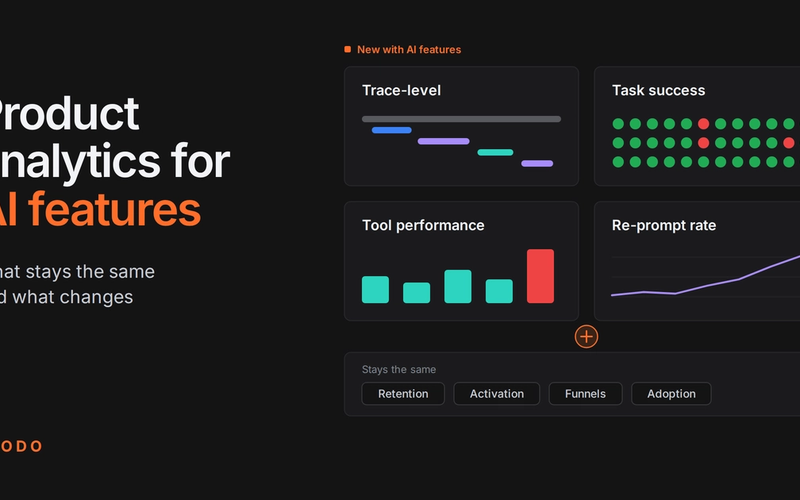
Product Analytics for Chatbots and AI Copilots
How to measure, improve, and grow products built around chatbots and AI copilots, the product analytics approach that goes beyond session counts to trace-level behavioral insight.
Chatbots and AI copilots have become the primary interface for a growing category of products, from customer support automation to enterprise productivity tools. Yet product analytics for chatbots remains surprisingly underdeveloped. Most teams track session volume, occasionally look at satisfaction ratings, and call it done. That leaves enormous insight gaps that prevent teams from systematically improving their conversational products.
#What makes chatbot analytics different?
Traditional product analytics tracks navigation across screens and user journeys through discrete steps. Chatbot interactions do not follow a fixed path. Each conversation is unique: the user chooses what to ask, the AI determines what to do about it, and the sequence of steps varies every time. Standard funnel analysis and event tracking cannot capture this structure without extensive custom work.
Effective chatbot analytics requires a conversation-native data model, one that represents the full structure of each interaction: the user's intent, the bot's decision-making, the tools or APIs called, and the outcome delivered. That is trace-based analytics applied to conversational products.
#Key metrics for chatbot products
#Containment rate
Containment rate measures the percentage of conversations the chatbot resolves without escalating to a human agent or fallback path. For customer-facing chatbots, this is often the primary business KPI. For enterprise copilots, the equivalent is task self-service rate, how often users accomplish their goal through the AI without needing additional support.
#Intent recognition accuracy
Did the chatbot correctly understand what the user was asking for? Intent recognition accuracy is best measured by comparing the chatbot's interpreted intent against the user's follow-up behavior: if the user immediately rephrases or switches topic, the initial intent was probably misunderstood. High misinterpretation rates on specific intent categories point directly to where NLU or prompt engineering improvements will have the biggest impact.
#Conversation abandonment rate
How often do users start a conversation and leave before getting a useful answer? Abandonment rate, especially broken down by conversation stage, reveals where chatbots lose users. High abandonment early in conversations usually indicates a UX or trust problem. High abandonment in the middle of a flow usually indicates a capability or accuracy problem.
#Topic distribution and coverage gaps
What are users actually asking your chatbot about? Topic distribution analysis identifies the most common user intents and flags areas where your chatbot has poor coverage, it hears the questions but cannot answer them well. Coverage gaps are direct input to your roadmap: they tell you where to expand capability, improve prompts, or add new tools.
#Retention analytics for chatbot products
The ultimate measure of a chatbot product's value is whether users return. Retention analytics for chatbots should segment users by their chatbot success rate: do users who consistently get useful answers retain better than those who frequently hit dead ends? If yes, and it almost always is, you have a clear, data-driven case for investing in chatbot quality improvements.
#Conversation-level vs. session-level analytics
Most analytics platforms track chatbot behavior at the session level: sessions started, sessions with chatbot interaction, session length. Session-level data is a starting point, not an endpoint. Conversation-level analytics, which tracks the internal structure of each conversation, including multi-turn coherence, context retention, and step-level success, gives you the depth needed to actually improve the chatbot rather than just monitor it.
#How Trodo approaches chatbot and copilot analytics
Trodo is built for the conversation-native analytics model that chatbot and copilot products require. It captures the full structure of each AI interaction as a trace, connects those traces to user accounts and segments, and surfaces behavioral patterns through a natural language interface. Product managers can ask "where are users abandoning the onboarding chatbot?" or "which conversation topics have the lowest satisfaction scores?" and get actionable answers immediately, without engineering a custom analytics pipeline.