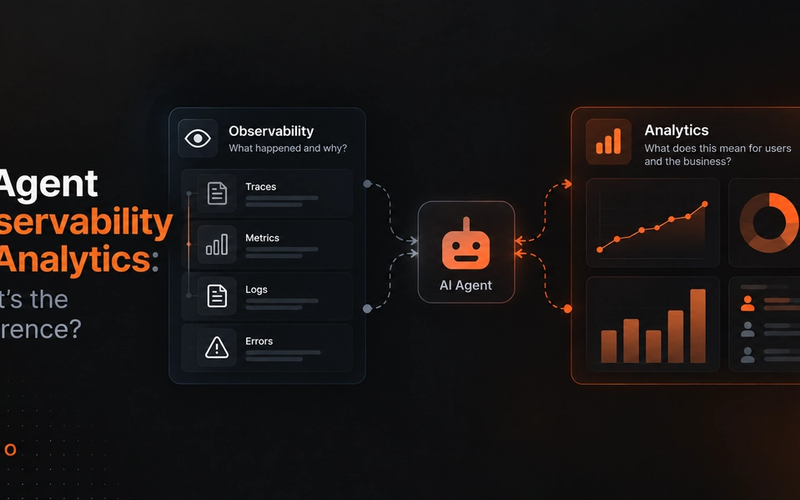
LLM Observability vs Product Analytics: Two Tools, One Goal
LLM observability and product analytics answer different questions for different teams, but they share one goal: making AI products better. Here is how to use both effectively.
LLM observability and product analytics are two distinct disciplines that are increasingly important for the same category of product: AI-native applications. Teams shipping LLM-powered features need both, but they often conflate them, buy only one, and end up with critical measurement gaps. This article clarifies what each does, who it serves, and how they work together to make AI products better.
#What LLM observability does
LLM observability is the practice of monitoring the technical behavior of large language model systems in production. It is directly descended from distributed systems observability — the practice of making complex, multi-service backend systems debuggable through structured logs, metrics, and traces.
Applied to LLMs and AI agents, observability captures: prompt inputs and model outputs, token usage and cost per request, inference latency by model and prompt version, span-level timing across agent chains, error rates and failure modes, and evaluation scores comparing model outputs against reference answers. Tools in this category include Langfuse, Helicone, LangSmith, Braintrust, and W&B Weave.
#Who uses LLM observability
LLM observability is primarily used by ML engineers, AI infrastructure engineers, and technical leads. It answers questions like: "Why did this prompt produce a bad output?" "Which model version has lower hallucination rates on our evaluation set?" "Where is the latency spike in our agent chain?" These are engineering questions requiring engineering-level data granularity.
#What product analytics does
Product analytics measures how users interact with a product and translates that interaction data into insights about adoption, retention, and value delivery. Traditional product analytics tracks events — page views, button clicks, feature interactions — and connects them to user-level and cohort-level outcomes. For AI-powered products, product analytics must extend to capture the behavioral patterns of users engaging with AI features: task success, re-prompt rate, abandonment at specific conversation stages, and retention correlation with successful AI interactions.
#Who uses product analytics
Product analytics is used by product managers, growth teams, and product-minded executives. It answers questions like: "Which user segments are successfully adopting the AI assistant?" "Where are users dropping off in the onboarding flow?" "Do users who complete AI-assisted tasks retain better at 30 days?" These are product and business questions requiring behavioral and cohort data, not raw model telemetry.
#Why you need both
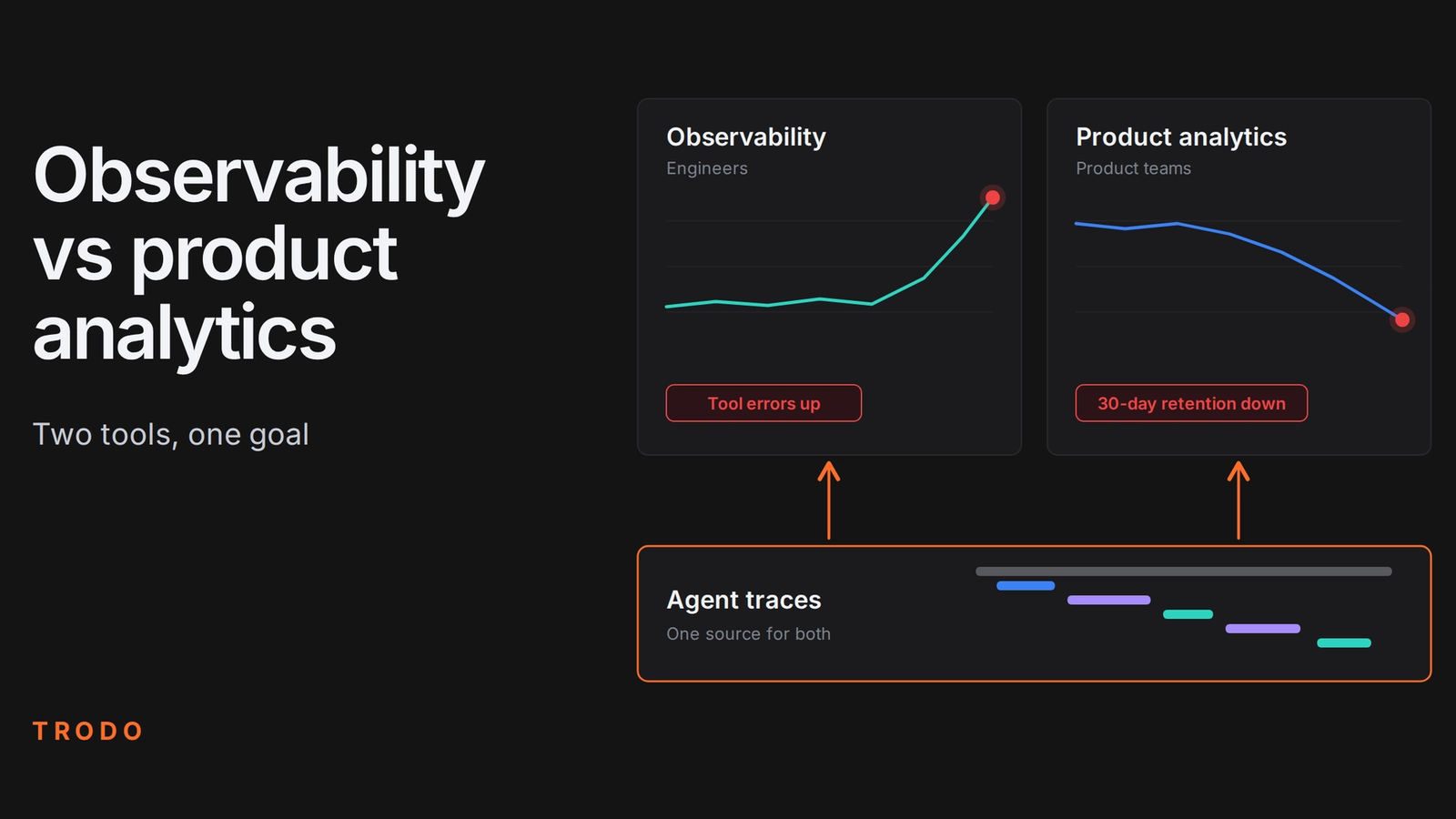
The complementarity between LLM observability and product analytics becomes clear when you face a real problem. Suppose your 30-day retention drops for a cohort that signed up after your AI assistant launched. Product analytics tells you retention dropped and that it is correlated with sessions where users interacted with the AI assistant. LLM observability tells you that a specific tool in the agent chain started returning higher error rates around the same time. Neither alone gives you the full picture. Together, they pinpoint the root cause.
#The data that connects them: agent traces
Agent traces are the connective tissue between LLM observability and product analytics. A trace records the complete lifecycle of an AI agent run — every step, tool call, model request, and output — in a structured, hierarchical format. Observability tools consume traces to support engineering debugging. Product analytics platforms consume the same traces to surface user-level behavioral patterns and business insights.
This is why trace instrumentation is the single most important technical investment for AI product teams. A well-structured trace powers both disciplines from a single data source, eliminating the need to instrument the system twice for different audiences.
#Building your AI analytics stack
- Start with trace instrumentation — emit structured traces for every AI interaction before choosing your tools
- Use an LLM observability tool for engineering debugging and model evaluation (Langfuse, LangSmith, Helicone)
- Use an AI product analytics platform for behavioral insights, retention analysis, and roadmap prioritization
- Ensure both tools can consume the same trace format to avoid duplicate instrumentation
- Create shared definitions of "task success" that both engineering and product teams agree on
#How Trodo fits in the AI analytics stack
Trodo is the product analytics layer of the AI analytics stack. It ingests agent traces natively, connects them to user accounts and behavioral patterns, and surfaces insights through a natural language interface designed for product managers and growth teams. It works alongside LLM observability tools, not instead of them — giving every stakeholder in an AI product organization the specific data layer they need to do their best work.