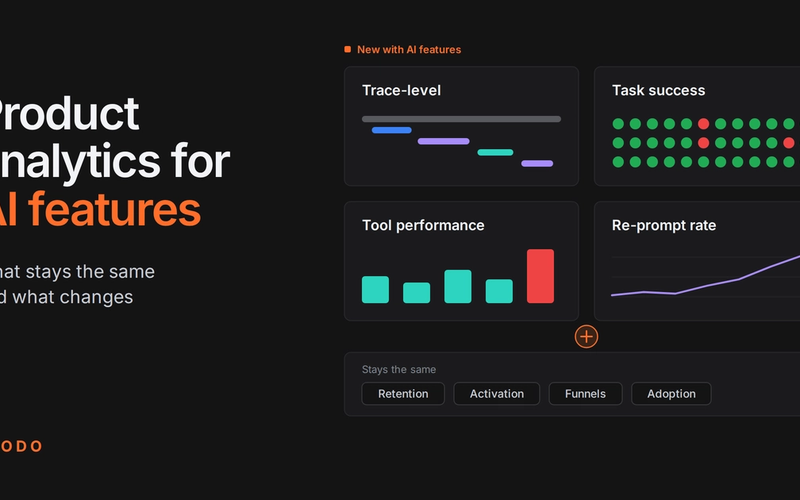
How to Measure AI Agent Performance: Traces, Tool Calls & KPIs
A practical guide to the KPIs, metrics, and measurement approaches that product teams use to evaluate AI agent performance in production — from trace-level data to business outcomes.
Measuring AI agent performance is one of the most important and least standardized challenges in AI product development today. Unlike traditional software where correctness is binary and latency is the primary quality signal, AI agents operate in a space where success is often ambiguous, multi-step, and highly context-dependent. This guide covers the practical KPIs and measurement approaches that leading product teams use to evaluate and improve their agents in production.
#Why measuring AI agent performance is hard
Traditional software performance is straightforward: did the function return the right value in under 200ms? AI agent performance is harder because the output is often a natural language response, not a verifiable data type. Additionally, a single agent run may involve 10–20 internal steps, each of which can succeed or fail independently. An agent that completes 18 of 20 steps correctly but fails on step 19 may still produce a poor user experience — or it may recover gracefully. You need metrics at every level.
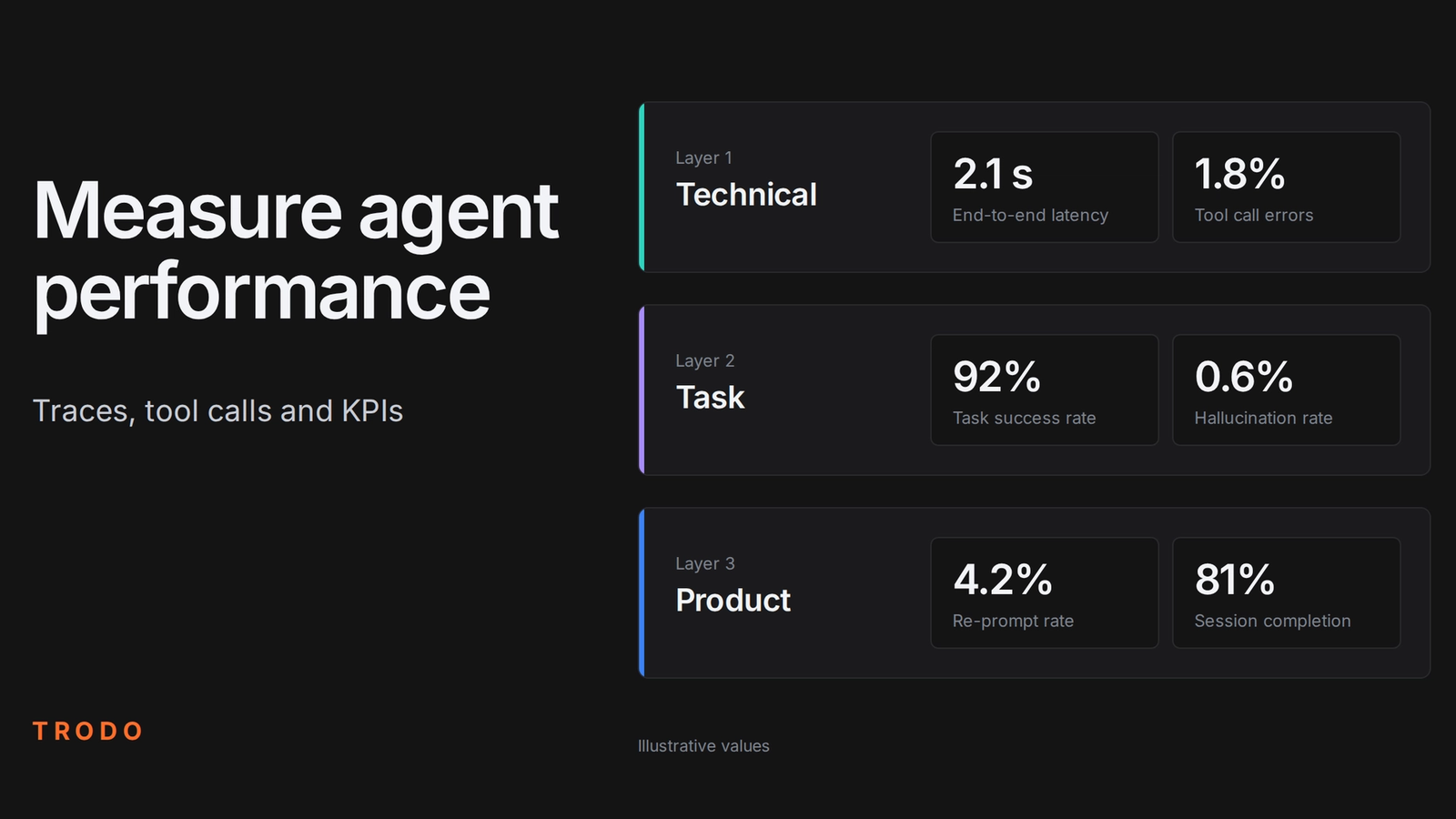
#The three layers of AI agent performance measurement
#Layer 1: Technical performance (engineering metrics)
- End-to-end latency — total time from user input to final response
- Span-level latency — time spent in each individual step (retrieval, reasoning, API calls)
- Token usage — input/output tokens per run, segmented by model and task type
- Tool call error rate — percentage of tool invocations that return errors, timeouts, or invalid responses
- Retry rate — how often the agent retries failed steps before succeeding or giving up
#Layer 2: Task performance (behavioral metrics)
- Task success rate — did the agent complete the intended task? Requires either explicit user feedback or an automated evaluator
- Tool usage accuracy — did the agent call the right tools in the right order for the given intent?
- Hallucination rate — how often does the agent assert things that are factually wrong or not supported by retrieved context?
- Context utilization — how well does the agent use retrieved documents or tool outputs in its final response?
- Escalation rate — how often does the agent fail and escalate to a human or fallback path?
#Layer 3: Product performance (user and business metrics)
- User satisfaction score — explicit (thumbs up/down, ratings) or implicit (session length, return visits)
- Re-prompt rate — how often users rephrase the same question, signaling the agent failed to understand or deliver
- Session completion rate — how often users reach their goal within a session versus abandoning
- Feature adoption by cohort — which user segments are successfully adopting agent-powered features versus avoiding them
- Retention correlation — do users who successfully complete agent tasks retain at higher rates?
#Setting up measurement: traces first
The foundation of AI agent performance measurement is structured tracing. Every agent run should emit a trace — a hierarchical record of each step, its inputs and outputs, its latency, and its success status. Without traces, you can only see aggregate error rates and latency averages, which tell you something is wrong but not where or why.
Traces should be linked to user accounts so you can compare agent behavior across segments. A trace that looks healthy in aggregate may reveal that power users have very different patterns from free-tier or new users — and those differences often point directly to optimization opportunities.
#Common pitfalls when measuring agent performance
The most common mistake is optimizing exclusively for technical metrics — low latency, low cost — while ignoring task success and user satisfaction. An agent can be blazing fast and cheap while consistently failing to complete user tasks. The second most common mistake is relying solely on explicit user feedback (thumbs up/down), which captures only a fraction of real user sentiment. Implicit signals — re-prompt rate, session abandonment, feature avoidance — are often more reliable and always more complete.
#How Trodo helps you measure AI agent performance
Trodo ingests agent traces natively and surfaces all three performance layers — technical, behavioral, and product — in one unified view. You can ask questions like "which tool has the highest error rate for enterprise users this week?" or "show me the sessions where users had to re-prompt more than twice" without building custom dashboards or joining multiple data sources. That makes it practical for cross-functional teams to stay aligned on what agent performance actually means for the product.