AI Product Analytics: The 2026 Guide for AI-Native Teams
Everything product teams need to know about AI product analytics in 2026 — what it measures, how it differs from traditional analytics, and how to build a measurement foundation for AI-native applications.
AI product analytics is the practice of measuring how users interact with AI-powered features — and translating that measurement into product decisions. As AI moves from a novelty to the core interface of modern applications, product analytics must evolve with it. Traditional event tracking captures what users click; AI product analytics captures what users ask, what the AI does in response, and whether the outcome was actually useful.
#What has changed about product analytics in the AI era?
Until recently, product analytics was primarily about tracking user navigation across screens and features. A funnel showed you which steps users completed; retention showed you who came back; cohort analysis showed you behavioral differences across user groups. That model still works for traditional SaaS features, but it breaks down for AI.
AI features — especially agentic ones — do not follow a predictable path. A single natural language prompt can trigger dozens of backend steps: tool calls, retrievals, model reasoning, external API requests. The "funnel" is not a set of screens a user navigates — it is a dynamic chain of decisions the AI makes on behalf of the user. Measuring that requires a different data model.
#The four pillars of AI product analytics
#1. Usage and adoption
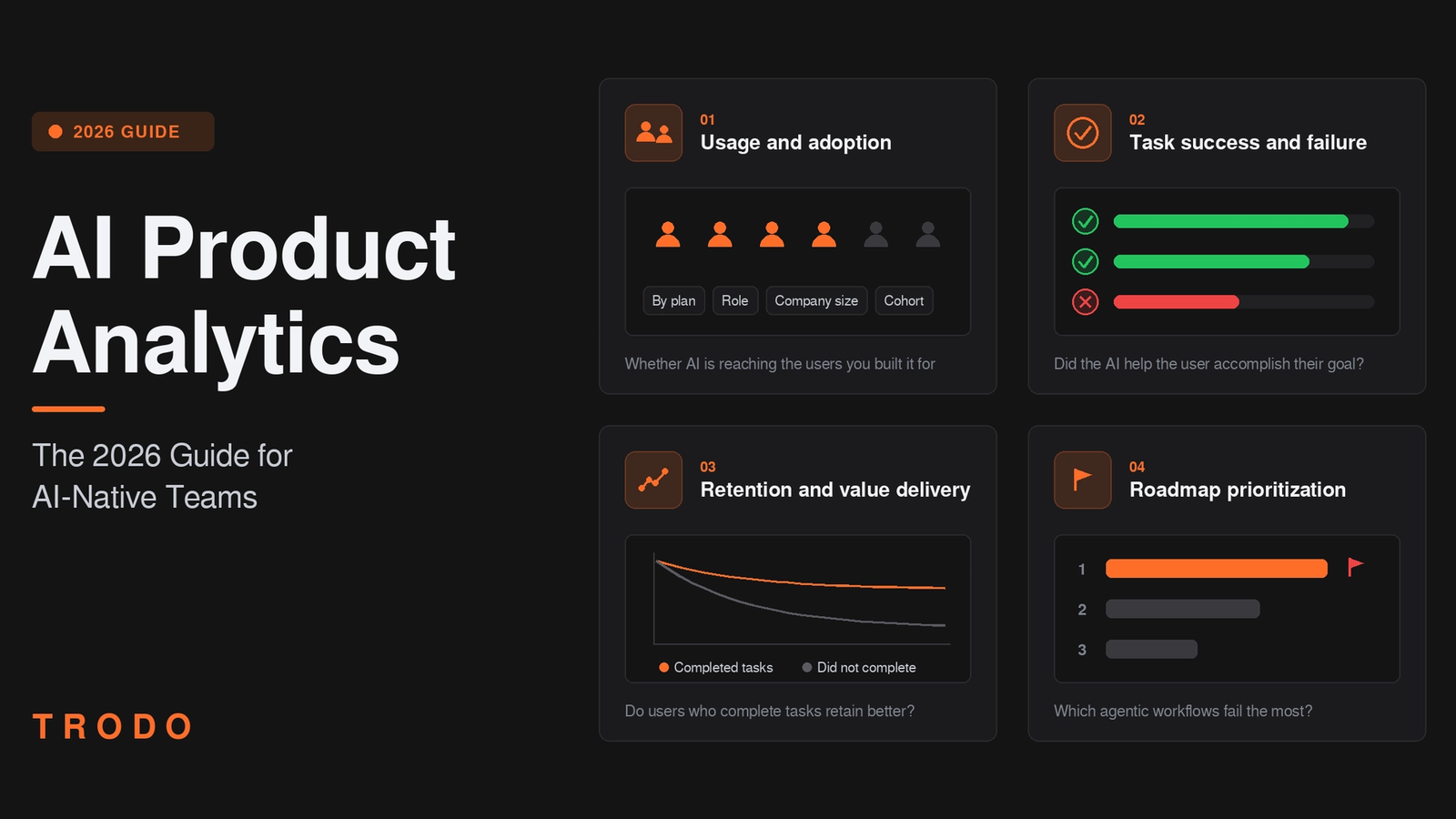
Which users are actually engaging with AI features? What percentage of sessions include an AI interaction? How does AI feature adoption differ by plan, role, company size, or onboarding cohort? Usage and adoption analytics tells you whether your AI investment is reaching the users you built it for — and flags early whether adoption is concentrated in a narrow segment.
#2. Task success and failure
Did the AI actually help the user accomplish what they came to do? Task success measurement requires combining agent trace data (did all steps complete without errors?) with user behavioral signals (did the user engage with the output, or immediately rephrase and try again?). Both signals together give a much more accurate picture of whether the AI is working than either one alone.
#3. Retention and value delivery
The most important long-term signal for any product is retention. For AI-powered products, the key question is: do users who successfully complete tasks with the AI retain better than those who do not? If yes, improving AI task success is a direct lever on retention. AI product analytics makes this connection explicit — linking agentic behavior to account-level outcomes.
#4. Roadmap prioritization
What should you build or improve next? AI product analytics gives product managers a data foundation for roadmap decisions that goes beyond "users asked for this in feedback." It shows which agentic workflows have the highest failure rates, which tool calls are consistently frustrating specific user segments, and which underutilized features are actually high-value when users do discover them.
#How AI product analytics differs from AI observability
AI observability (Langfuse, Helicone, LangSmith) monitors technical system health: token costs, latency, error rates, and model performance. AI product analytics translates that technical data into product and business insights: user retention, feature adoption, task success, and roadmap signals. Both are necessary; they serve different audiences and different questions.
#Getting started with AI product analytics
- Instrument agent runs as traces — capture the full structure of each AI interaction, not just aggregate event counts
- Link traces to user accounts — make it possible to compare AI behavior across segments and cohorts
- Define "task success" for your product — be explicit about what a good outcome looks like before you can measure whether you are achieving it
- Track implicit satisfaction signals — re-prompt rate and session abandonment often reveal frustration before explicit feedback does
- Connect AI behavior to retention — run cohort analysis across users who do and do not successfully engage with AI features
- Set baselines before optimizing — know where you are before you know where to go
#How Trodo powers AI product analytics
Trodo is an AI product analytics platform built specifically for the structure and complexity of agentic applications. It ingests traces natively, connects them to user and account data, and surfaces actionable insights through a natural language interface. Instead of building 15 custom dashboards to understand your AI product, you ask Trodo a question and get an answer in seconds. That is what AI product analytics looks like when the tool is built for the era it is measuring.