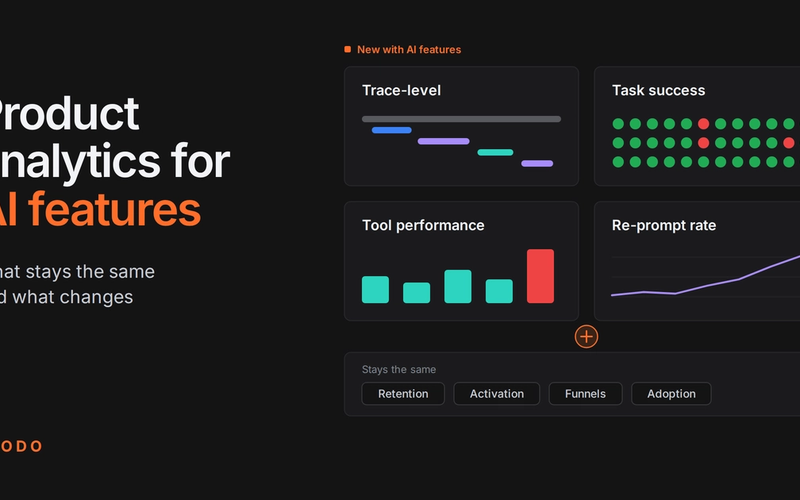
How to Measure AI Feature Adoption in Your Product
Measuring AI feature adoption requires different metrics than traditional feature tracking. This guide covers the frameworks, signals, and analytics approaches that work for AI-powered products.
AI feature adoption is one of the hardest things to measure in modern product development. You ship an AI-powered feature, and your event logs show users are technically "using" it — but whether they are actually getting value from it, returning because of it, or abandoning your product in silent frustration is far less clear. Measuring AI feature adoption properly requires a different set of signals than traditional feature tracking.
#Why traditional adoption metrics fall short for AI features
Traditional feature adoption is measured by activation events: did the user click the button, complete the setup, or reach a milestone? For non-AI features, that is a reasonable proxy for value delivery. For AI features, it is not. A user can trigger an AI feature, receive a response, and immediately close the window in frustration — and your analytics will show a successful "adoption" event.
The problem is that AI features are not consumed like buttons — they are interacted with conversationally and evaluated by whether they understand and fulfill intent. Measuring adoption without measuring that fulfillment is measuring the wrong thing.
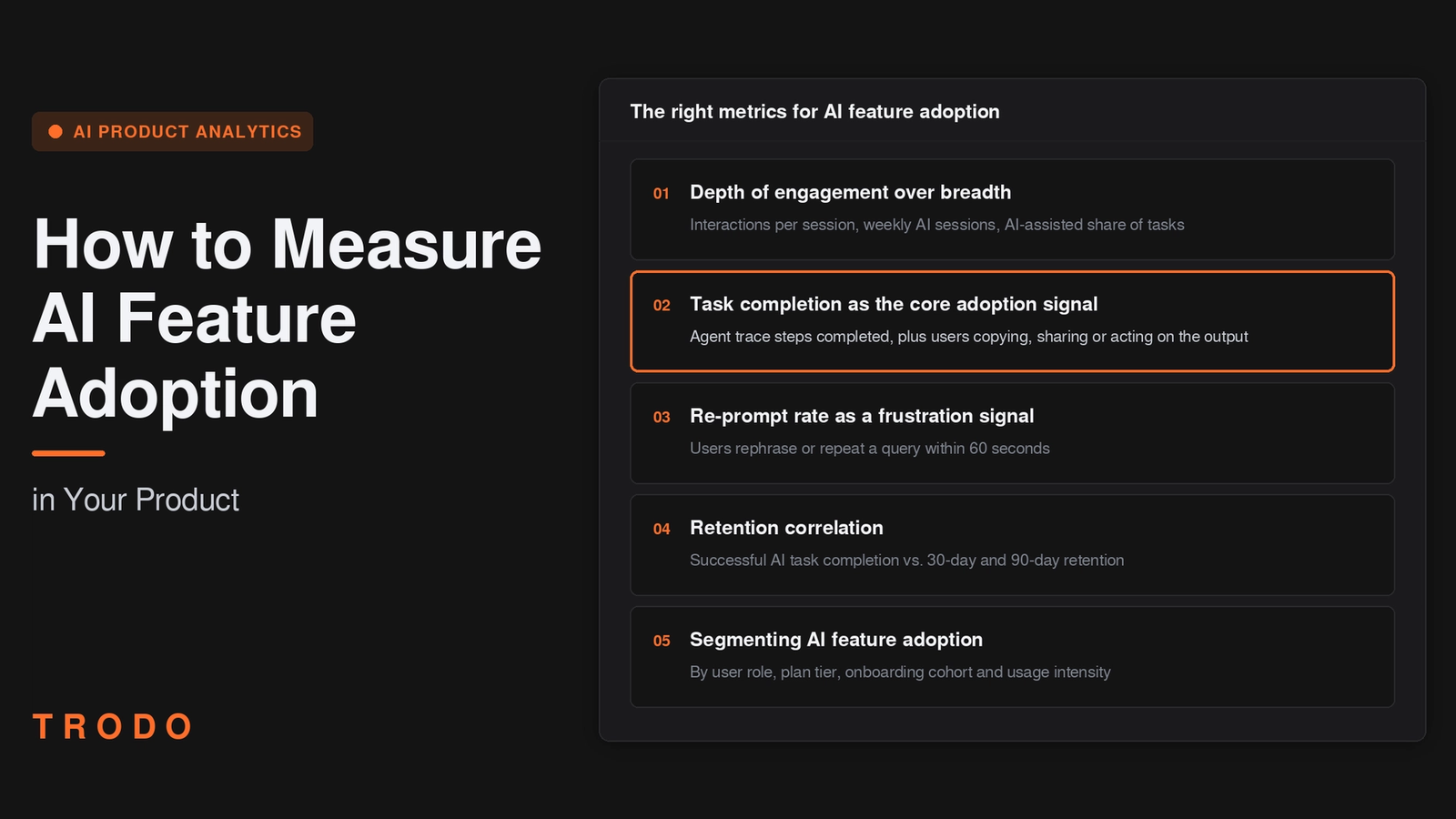
#The right metrics for AI feature adoption
#Depth of engagement over breadth
Look beyond "did the user use the feature once?" to "how deeply do they engage over time?" Depth metrics include: number of interactions per session, number of sessions that include the AI feature per week, and the ratio of AI-assisted tasks to total tasks completed. A user who interacts with your AI assistant 15 times per session and returns daily is demonstrating real adoption. A user who tries it once per week and barely engages is at risk.
#Task completion as the core adoption signal
Define what a "successful" AI interaction looks like for your product and measure it directly. This requires connecting agent trace data (did all steps complete?) with behavioral signals (did the user engage with the output, copy it, share it, or act on it?). Combining these gives you a "task completion rate" that is a much more honest adoption metric than raw activation counts.
#Re-prompt rate as a frustration signal
When a user immediately rephrases or repeats a query after receiving an AI response, it is a strong signal that the AI failed to fulfill their intent. Track re-prompt rate — the percentage of interactions where users rephrase within 60 seconds — as an inverse adoption signal. High re-prompt rate in a specific flow means your AI is not meeting user expectations there, and adoption will plateau until it improves.
#Retention correlation
The most powerful adoption signal for AI features is their impact on retention. Run a cohort analysis comparing users who successfully complete AI-assisted tasks versus those who do not. If successful AI engagement drives meaningfully higher 30-day and 90-day retention, you have validated that the feature delivers real value — and that improving it is a direct lever on business outcomes.
#Segmenting AI feature adoption
Aggregate adoption numbers hide important patterns. Segment AI feature adoption by user role, plan tier, onboarding cohort, and usage intensity. Power users often discover and leverage AI features that new or casual users never find. Understanding which segments are getting the most value — and which are not — tells you both where to focus UX improvements and which user types to prioritize in onboarding.
#Common AI feature adoption traps
- Measuring activation without completion — triggering the feature is not the same as deriving value from it
- Ignoring implicit signals — most frustrated users never give explicit negative feedback; they just stop using the feature
- Treating all user segments as one — power users and new users often have radically different AI adoption patterns
- Not connecting to retention — adoption that does not drive retention is usage without value
- Optimizing for speed over quality — fast AI responses that miss user intent drive worse long-term adoption than slower, more accurate ones
#Measuring AI feature adoption with Trodo
Trodo connects agent trace data with user-level behavioral signals so you can measure AI feature adoption with the depth that AI products require. Ask questions like "which user segment has the highest task completion rate on the AI assistant?" or "show me re-prompt rate trends for onboarding cohorts this month" — and get answers in seconds, without building custom analytics pipelines.