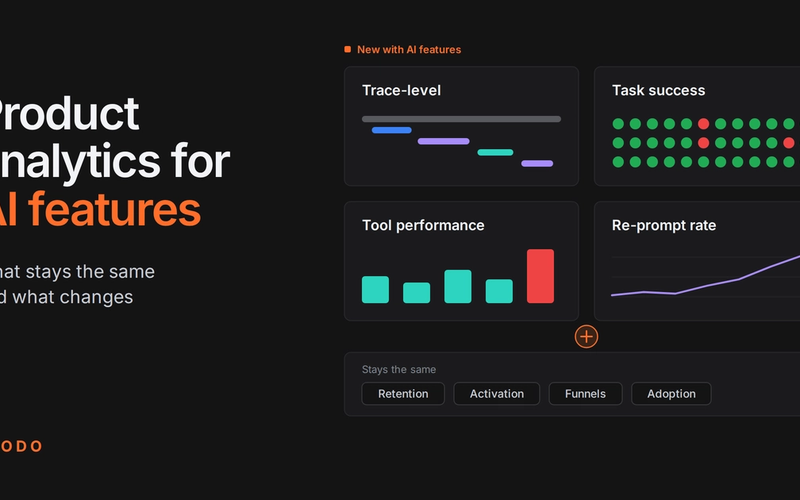
Best AI Agent Analytics Tools in 2026: Monitor LLM Agents at Scale
A practical comparison of the leading AI agent analytics tools in 2026 — covering what each does, who it is for, and how to choose the right stack for your product team.
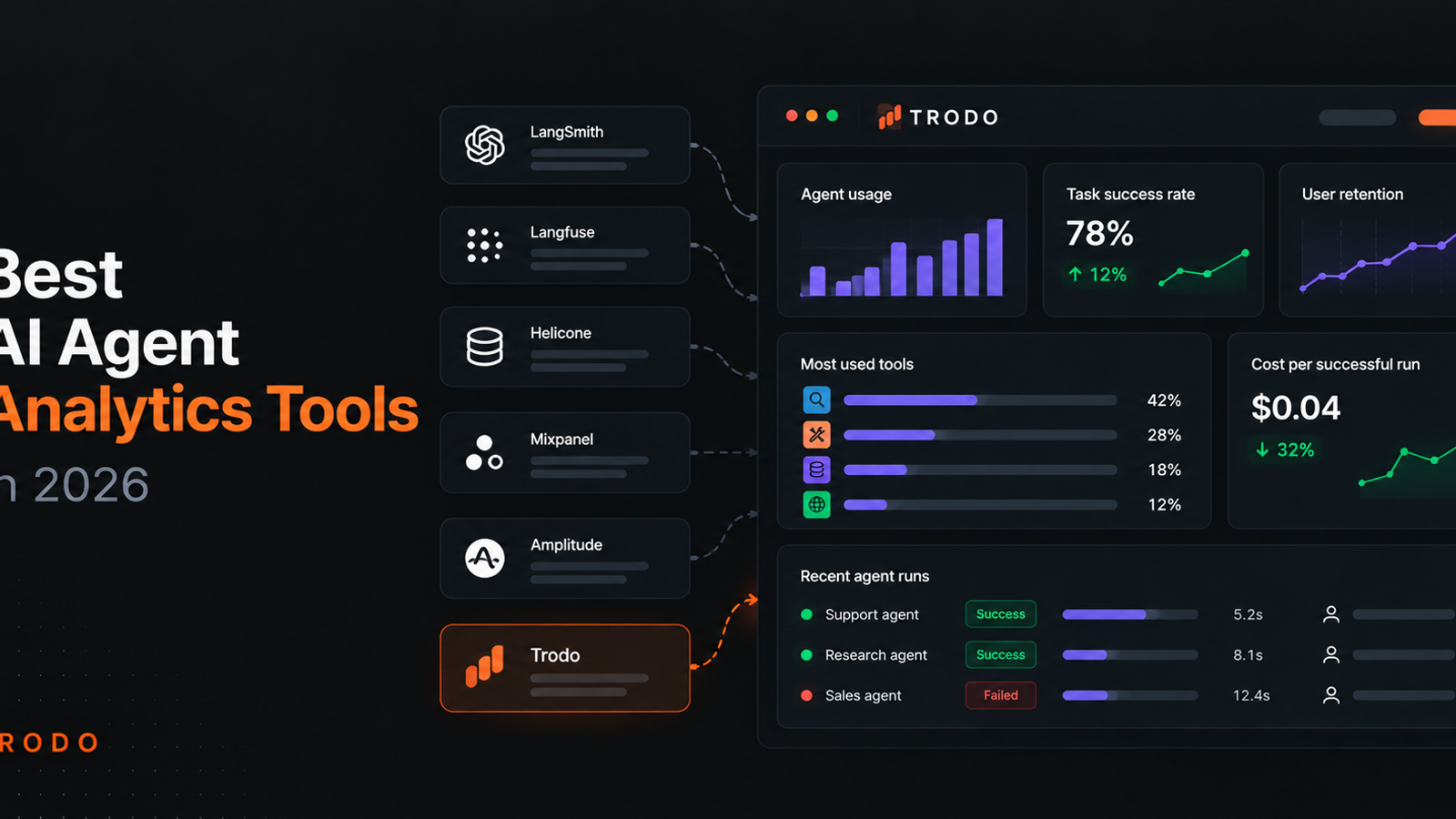
The market for AI agent analytics tools has expanded rapidly alongside the adoption of LLM-powered products. In 2026, product teams face a genuine choice between engineering-focused observability platforms, general-purpose product analytics, and purpose-built AI agent analytics solutions. Choosing wrong means either blind spots in your data or a dashboard your PM team never opens.
#What makes a good AI agent analytics tool?
A strong AI agent analytics tool does three things well: it captures the full structure of agent runs (traces, spans, tool calls), it connects that technical data to product-level outcomes (task success, retention, user satisfaction), and it makes those insights accessible to non-engineers without requiring custom dashboard builds. Tools that only do one or two of these create gaps that slow teams down.
#Category 1: LLM observability platforms
These tools focus on engineering-layer visibility: latency, token cost, model version tracking, and prompt debugging. Examples include Langfuse, LangSmith, Helicone, and Braintrust. They are excellent for ML engineers evaluating model quality and debugging production failures, but they are not built for product managers who want to understand user behavior and business impact.
#Best for
Engineering and ML teams that need trace-level debugging, prompt versioning, cost monitoring, and regression testing across model versions. Not designed for product analytics use cases like cohort analysis, retention, or funnel drop-off.
#Category 2: Traditional product analytics (with AI bolt-ons)
Mixpanel, Amplitude, and PostHog are mature platforms with strong track records for event-based product analytics. Each has added some LLM or AI event tracking in recent releases. However, their underlying data model — flat events with properties — was not designed for the hierarchical, trace-based structure of agent runs. Tracking agent behavior through flat events requires significant custom instrumentation and loses the relational context of spans and tool calls.
#Best for
Teams with established product analytics stacks who want to add lightweight AI event tracking without switching platforms. Limited for teams where agentic workflows are a core part of the product, not a peripheral feature.
#Category 3: Purpose-built AI agent analytics platforms
A new category of tools — including Trodo — is built from the ground up for the agent era. These platforms ingest traces natively, model the hierarchical structure of agent runs, and surface both engineering and product insights from a single data layer. They are designed so that product managers can query behavioral patterns with natural language, while engineers can drill into individual spans for debugging.
#Best for
Product teams where AI agents or chatbots are a primary user interaction point — not a side feature. Particularly valuable when cross-functional alignment between PM, engineering, and growth is a priority.
#Key capabilities to evaluate
- Native trace ingestion — does it understand span hierarchy without custom event mapping?
- Tool call analytics — can you see which tools fire, error rates, and latency per tool?
- User-level attribution — can you link agent traces to specific user accounts and cohorts?
- Natural language querying — can a non-engineer ask questions about the data in plain English?
- Retention and funnel analysis — does it support classic product analytics alongside agent-specific metrics?
- Alerting on agent failures — can you get notified when error rates spike for specific tools or flows?
#How to choose the right stack
For most teams building AI-first products, the right answer in 2026 is a layered stack: an LLM observability tool for engineering debugging combined with a product-focused AI agent analytics platform for behavioral and business insights. The two categories serve different audiences and different questions — and both are now necessary for serious AI product development.
Trodo is built for the product and growth side of this stack: connecting agent traces, tool call data, and user behavior into a single layer that helps you understand not just whether your AI works, but whether it is creating value for users and driving the business outcomes you care about.