TRODO
ProductPricingDocsBlog
Sign inGet started
ProductPricingDocsBlogSign in

Notes from the field. Evaluating and fixing agents in production.

TRODO

Every agent trace evaluated. Every failure fixed.

Product
  • Traces
  • Evaluations
  • Issues
  • Lucid
  • Alerts
  • Agents
  • Capabilities
  • Prompts
  • Playground
  • Reports
Models
  • Hartley 1
  • Benchmarks
  • API docs
Developers
  • Documentation
  • Start tracing
  • Your first evaluation
  • Instrumentation guide
  • Frameworks
  • OpenTelemetry
  • MCP server
  • Changelog
Company
  • Customers
  • Pricing
  • Blog
  • Talk to the founders
  • Careers
  • Contact
Trust
  • Trust center
  • Privacy policy
  • Terms of service

Product

  • Traces
  • Evaluations
  • Issues
  • Lucid
  • Alerts
  • Agents
  • Capabilities
  • Prompts
  • Playground
  • Reports

Models

  • Hartley 1
  • Benchmarks
  • API docs

Developers

  • Documentation
  • Start tracing
  • Your first evaluation
  • Instrumentation guide
  • Frameworks
  • OpenTelemetry
  • MCP server
  • Changelog

Company

  • Customers
  • Pricing
  • Blog
  • Talk to the founders
  • Careers
  • Contact

Trust

  • Trust center
  • Privacy policy
  • Terms of service
© 2026 Trodo. All rights reserved.
HumanAgent
SOC 2 Type I
Loading article…
TRODO
ProductPricingDocsBlog
Sign inGet started
ProductPricingDocsBlogSign in
Blog/Agent Analytics

Agent Analytics: Measuring AI Agents, Tools, and Traces in Production

A practical guide to agent analytics: tracing orchestrations, tool calls, latency, and failure modes so you can ship reliable AI features and prove value with data.

Trodo·March 22, 2026·10 min read

On this page

  1. What “agent analytics” measures
  2. Tracing and spans
  3. Tool and policy governance
  4. Agent analytics and product outcomes
  5. How Trodo thinks about agents

Agent analytics focuses on AI systems that plan, call tools, and produce user-visible outcomes—not just page views. When your product includes assistants, copilots, or autonomous workflows, classic product analytics alone may miss what matters: which prompts fail, which tools error, where latency spikes, and which agent paths drive successful tasks.

#What “agent analytics” measures

At a minimum, teams track end-to-end runs: user intent → model steps → tool invocations → final response. In production, that usually means traces (structured timelines of work), spans for sub-steps, and attributes such as model version, policy flags, and cost estimates. Agent analytics turns those traces into product metrics: task success rate, time-to-resolution, tool error rate, and escalation frequency.

#Tracing and spans

A trace represents one user- or system-initiated job: “summarize this document,” “run this workflow,” “debug this error.” Spans break the trace into pieces—retrieval, reasoning, API calls, database reads—so you can see what slowed down or failed. Strong agent analytics makes traces first-class so PMs and engineers share one view of reality.

#Tool and policy governance

Agents that call external APIs or internal services need guardrails. Agent analytics helps you audit which tools fire, what inputs they receive, and how often policies block or rewrite actions. That is essential for security reviews and for improving prompts and tool schemas over time.

#Agent analytics and product outcomes

The point of agent analytics is not only reliability—it is product impact. Pair agent traces with account- and cohort-level outcomes: expansion, retention, support tickets avoided, or tasks completed without human help. That is how you justify investment in better models, better tools, and better UX around AI features.

#How Trodo thinks about agents

Trodo treats events and agent traces as part of one product story: how people move through your product, including AI-assisted paths. Connecting behavioral analytics with agent analytics helps teams ship AI that is measurable, safe, and aligned with business results—not just demos that look good in the lab.
Every trace evaluated, for a fraction of the cost. See it on your agent.

Get startedTalk to the founders

Keep reading

April 22, 2026 · 13 min read

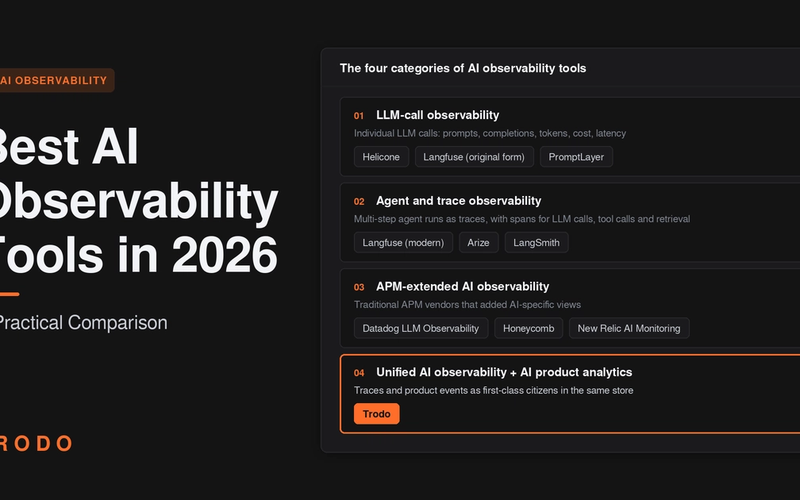
Best AI Observability Tools in 2026: A Practical Comparison

April 22, 2026 · 10 min read

Agent Analytics vs Agent Observability vs LLM Observability: Clear Definitions

April 17, 2026 · 9 min read

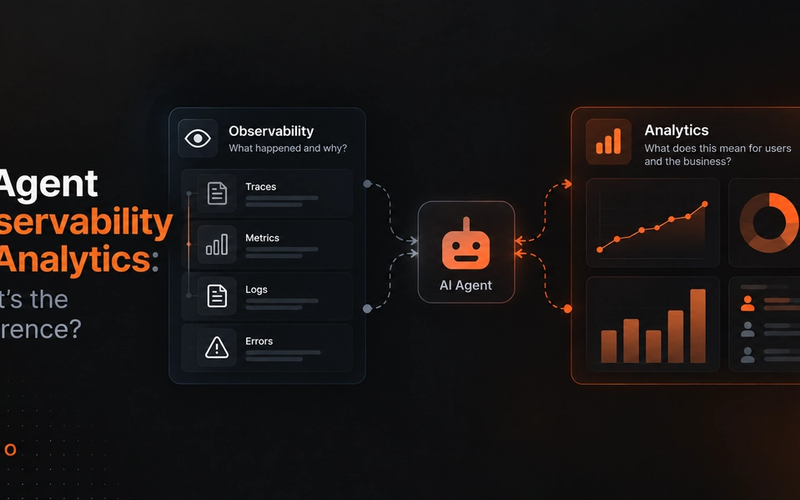
AI Agent Observability vs Analytics: What's the Difference?

TRODO

Every agent trace evaluated. Every failure fixed.

Product
  • Traces
  • Evaluations
  • Issues
  • Lucid
  • Alerts
  • Agents
  • Capabilities
  • Prompts
  • Playground
  • Reports
Models
  • Hartley 1
  • Benchmarks
  • API docs
Developers
  • Documentation
  • Start tracing
  • Your first evaluation
  • Instrumentation guide
  • Frameworks
  • OpenTelemetry
  • MCP server
  • Changelog
Company
  • Customers
  • Pricing
  • Blog
  • Talk to the founders
  • Careers
  • Contact
Trust
  • Trust center
  • Privacy policy
  • Terms of service

Product

  • Traces
  • Evaluations
  • Issues
  • Lucid
  • Alerts
  • Agents
  • Capabilities
  • Prompts
  • Playground
  • Reports

Models

  • Hartley 1
  • Benchmarks
  • API docs

Developers

  • Documentation
  • Start tracing
  • Your first evaluation
  • Instrumentation guide
  • Frameworks
  • OpenTelemetry
  • MCP server
  • Changelog

Company

  • Customers
  • Pricing
  • Blog
  • Talk to the founders
  • Careers
  • Contact

Trust

  • Trust center
  • Privacy policy
  • Terms of service
© 2026 Trodo. All rights reserved.
HumanAgent
SOC 2 Type I